

Ward designs and manufactures bucket elevators for the vertical handling of dry bulk materials. Centrifugal and continuous-discharge designs are available with belt or chain conveying elements for foundry, mineral, aggregate, metal-processing and other demanding bulk-material-handling applications.
Correct selection depends on the material, required capacity, vertical lift and operating conditions. Bulk density, lump size, moisture, abrasiveness, temperature, flow characteristics and sensitivity to degradation all influence the elevator type, bucket design, speed and construction.
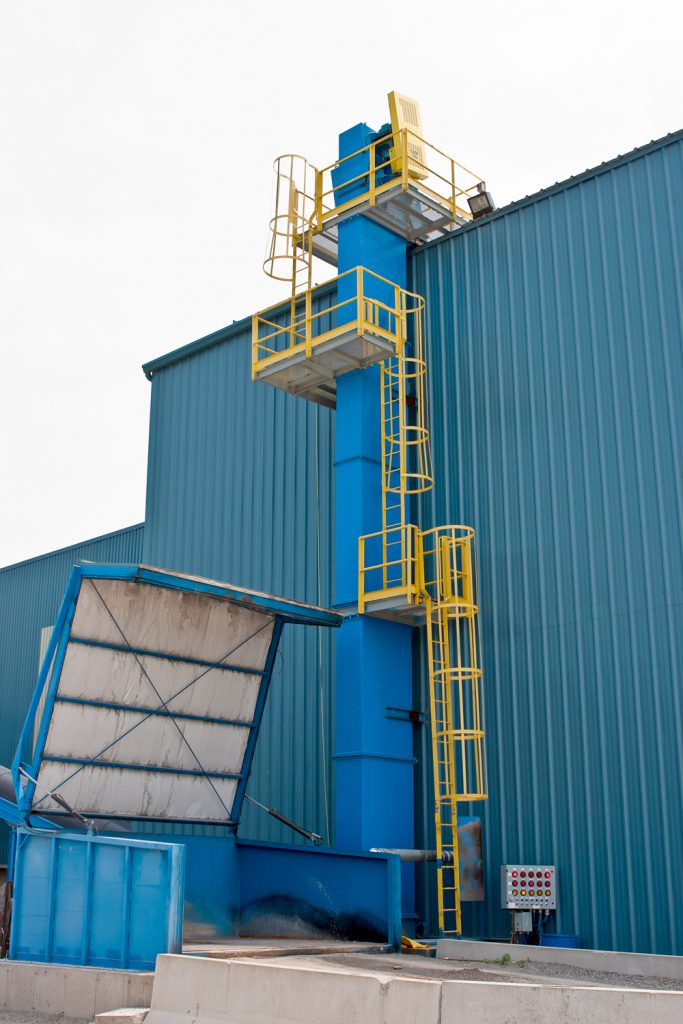
A bucket elevator carries bulk material vertically in buckets attached to a moving belt or chain inside an enclosed casing. Material enters at the boot, travels upward through the casing and discharges through the head section.
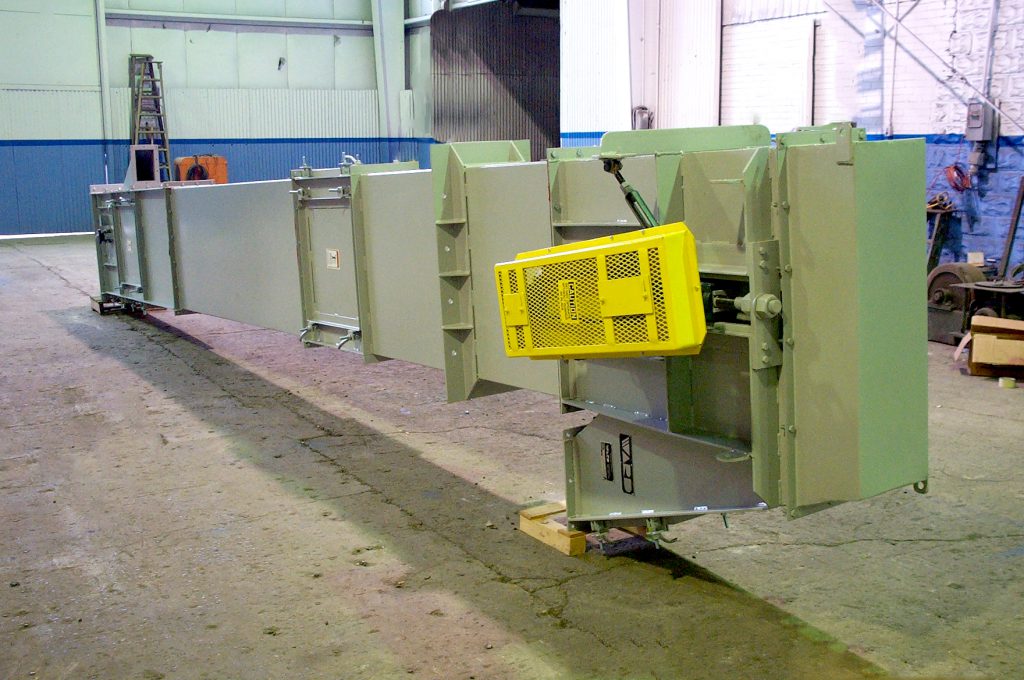
The two principal designs are centrifugal-discharge and continuous-discharge elevators. Their main difference is how the buckets are arranged, operated and discharged.
| Design Consideration | Centrifugal Discharge | Continuous Discharge |
|---|---|---|
| Bucket Arrangement | Spaced buckets | Closely spaced or overlapping buckets |
| Typical Operating Speed | Higher | Lower |
| Discharge Method | Material is projected from the bucket at the head | Material flows from each bucket over the preceding bucket |
| Feeding Method | Buckets commonly pick up material from the boot | Material is normally directed into the buckets |
| Material Handling | More energetic loading and discharge | Gentler and more controlled loading and discharge |
| Typical Materials | Free-flowing materials and moderate lump sizes | Fragile, abrasive, sluggish or larger-lump materials |
| Typical Application | Often selected for higher-rate handling of free-flowing materials | Often selected where controlled handling and reduced product degradation are important |
| Conveying Element | Belt or chain | Belt or chain |
Final selection must be based on the actual material and duty. Two products with the same bulk density can behave very differently because of moisture, particle shape, temperature, friability or flow characteristics.
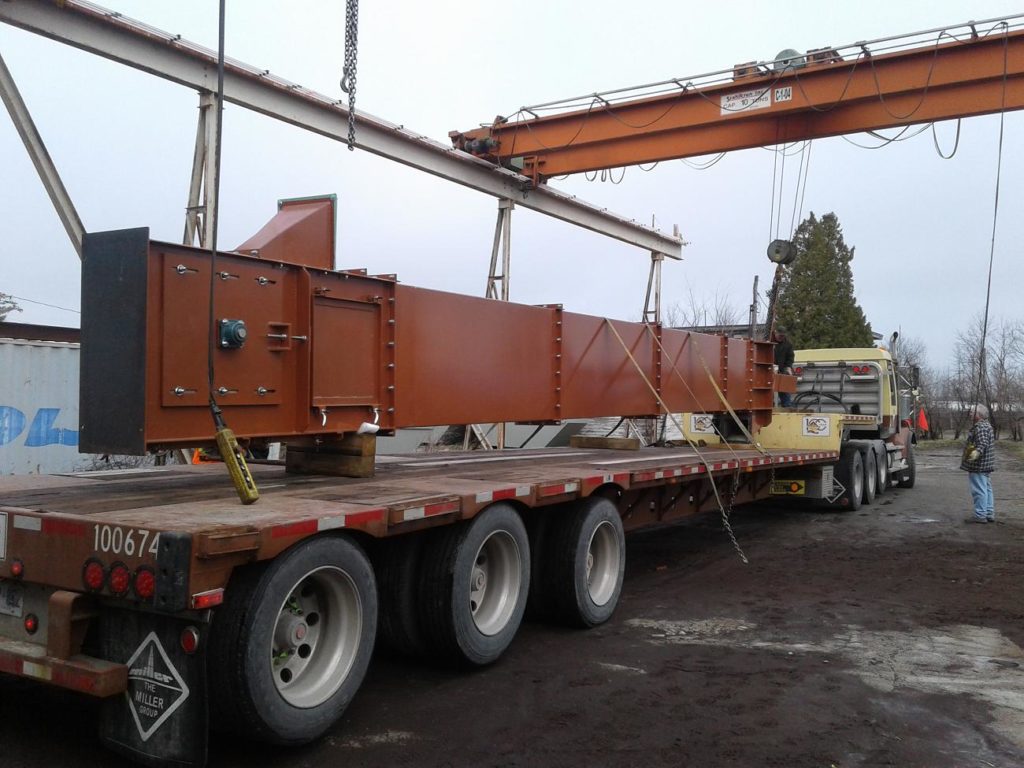
A centrifugal bucket elevator uses spaced buckets operating at a comparatively high speed. Material enters the boot and is picked up by the buckets. As each bucket passes around the head pulley or sprocket, its speed and changing direction cause the material to leave the bucket and enter the discharge chute.
Centrifugal elevators are commonly used for free-flowing materials, moderate lump sizes and higher-capacity applications. Pulley diameter, elevator speed, bucket shape, spacing and discharge geometry must work together to produce a clean discharge.
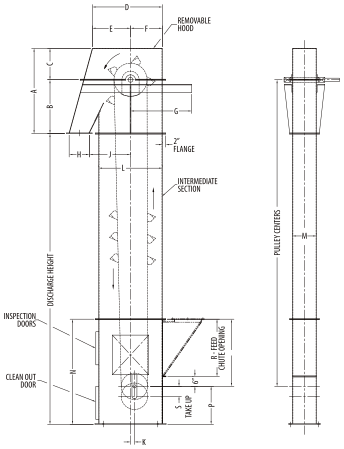
Capacities shown are preliminary and depend on material density, bucket fill, operating speed and feed conditions. Final dimensions and equipment selection must be confirmed for the specific application.
| Model number | Suffix | Bucket | Belt | Bucket Capacity | Elevator Capacity | Rate @ | Head Section | Pulley Offset | Casing | Boot Section | |||||||
|---|---|---|---|---|---|---|---|---|---|---|---|---|---|---|---|---|---|
| Size (x, y, z) | Width (in.) |
Gross Cu. Ft. |
Net Cu. Ft. |
CFH | 50 lbs./cu.ft. STPH |
100 lbs./cu.ft. STPH |
A | D | H | J | K | L | M | N | R | ||
| (inch) | |||||||||||||||||
| Single Row Elevators | |||||||||||||||||
| PR-BE-CD-533 | * | 5 x 3 ½ x 3 ¾ ″A″ | 6 | 0.018 | 0.014 | 190 | 4.8 | 9.5 | 3′-10 ¾″ | 3′-5″ | 1′-0″ | 1′-11 ½″ | 2″ | 2′-11″ | 11.0 | 5′-4″ | 3′-1″ |
| PR-BE-CD-64 | * | 6 x 4 x 4 ¼ ″A″ | 7 | 0.030 | 0.023 | 280 | 7.0 | 14.0 | 3′-10 ¾″ | 3′-5″ | 1′-0″ | 1′-11 ½″ | 2″ | 2′-11″ | 11.0 | 5′-4″ | 3′-1″ |
| PR-BE-CD-85 | * | 8 x 5 x 5 ½ | 9 | 0.068 | 0.051 | 734 | 18.4 | 36.7 | 4′-3 ½″ | 3′-6 ¼″ | 1′-0″ | 2′-1″ | 2″ | 3′-2″ | 14.0 | 5′-6″ | 3′-1″ |
| PR-BE-CD-106 | * | 10 x 6 x 6 ¼ | 11 | 0.119 | 0.089 | 1,078 | 26.9 | 53.9 | 4′-4″ | 3′-8 ¼″ | 1′-0″ | 2′-2″ | 3″ | 3′-4″ | 16.0 | 5′-6″ | 3′-1″ |
| PR-BE-CD-127 | * | 12 x 7 x 7 ¼ | 13 | 0.194 | 0.146 | 1,746 | 43.7 | 87.3 | 5′-4″ | 4′-7″ | 1′-1″ | 2′-10″ | 3″ | 4′-0″ | 18.0 | 6′-0″ | 3′-4″ |
| PR-BE-CD-147 | * | 14 x 7 x 7 ¼ | 15 | 0.226 | 0.170 | 2,034 | 50.9 | 101.7 | 5′-4″ | 4′-7″ | 1′-1″ | 2′-10″ | 3″ | 4′-0″ | 20.0 | 6′-0″ | 3′-4″ |
| PR-BE-CD-148 | * | 14 x 8 x 8 ½ | 15 | 0.297 | 0.223 | 2,673 | 66.8 | 133.7 | 5′-4″ | 4′-7″ | 1′-1″ | 2′-10″ | 3″ | 4′-0″ | 20.0 | 6′-0″ | 3′-4″ |
| PR-BE-CD-168 | * | 16 x 8 x 8 ½ | 18 | 0.339 | 0.254 | 3,051 | 76.3 | 152.6 | 5′-4″ | 4′-7″ | 1′-1″ | 2′-10″ | 3″ | 4′-0″ | 22.0 | 6′-0″ | 3′-4″ |
| PR-BE-CD-188 | * | 18 x 8 x 8 ½ | 20 | 0.381 | 0.286 | 3,429 | 85.7 | 171.5 | 5′-4″ | 4′-7″ | 1′-1″ | 2′-10″ | 3″ | 4′-0″ | 24.0 | 6′-0″ | 3′-4″ |
| PR-BE-CD-208 | * | 20 x 8 x 8 ½ | 22 | 0.423 | 0.317 | 3,807 | 95.2 | 190.4 | 5′-4″ | 4′-7″ | 1′-1″ | 2′-10″ | 3″ | 4′-0″ | 26.0 | 6′-0″ | 3′-4″ |
| PR-BE-CD-248 | * | 24 x 8 x 8 ½ | 26 | 0.495 | 0.371 | 4,455 | 111.4 | 222.8 | 5′-4″ | 4′-7″ | 1′-1″ | 2′-10″ | 3″ | 4′-0″ | 30.0 | 6′-0″ | 3′-4″ |
| PR-BE-CD-1810 | * | 18 x 10 x 10 ½ | 20 | 0.565 | 0.424 | 4,794 | 119.9 | 239.7 | 6′-0″ | 5′-5″ | 1′-3″ | 3′-3″ | 3″ | 4′-10″ | 24.0 | 6′-5″ | 3′-4″ |
| PR-BE-CD-2010 | * | 20 x 10 x 10 ½ | 22 | 0.628 | 0.471 | 5,329 | 133.2 | 266.5 | 6′-0″ | 5′-5″ | 1′-3″ | 3′-3″ | 3″ | 4′-10″ | 26.0 | 6′-5″ | 3′-4″ |
| PR-BE-CD-2410 | * | 24 x 10 x 10 ½ | 26 | 0.753 | 0.565 | 6,390 | 159.7 | 319.5 | 6′-0″ | 5′-5″ | 1′-3″ | 3′-3″ | 3″ | 4′-10″ | 30.0 | 6′-5″ | 3′-4″ |
| Double Row Elevators | |||||||||||||||||
| PR-BE-DCD-148 | * | (2) x 14 x 8 x 8 ½ | 30 | 0.297 | 0.180 | 4,320 | 108.0 | 216.0 | 5′-4″ | 4′-7″ | 1′-1″ | 2′-10″ | 3″ | 4′-0″ | 34.0 | 6′-0″ | 3′-4″ |
| PR-BE-DCD-168 | * | (2) x 16 x 8 x 8 ½ | 34 | 0.339 | 0.204 | 4,896 | 122.4 | 244.8 | 5′-4″ | 4′-7″ | 1′-1″ | 2′-10″ | 3″ | 4′-0″ | 38.0 | 6′-0″ | 3′-4″ |
| PR-BE-DCD-188 | * | (2) x 18 x 8 x 8 ½ | 38 | 0.381 | 0.234 | 5,616 | 140.4 | 280.8 | 5′-4″ | 4′-7″ | 1′-1″ | 2′-10″ | 3″ | 4′-0″ | 42.0 | 6′-0″ | 3′-4″ |
| PR-BE-DCD-208 | * | (2) x 20 x 8 x 8 ½ | 42 | 0.423 | 0.258 | 6,192 | 154.8 | 309.6 | 5′-4″ | 4′-7″ | 1′-1″ | 2′-10″ | 3″ | 4′-0″ | 46.0 | 6′-0″ | 3′-4″ |
| PR-BE-DCD-248 | * | (2) x 24 x 8 x 8 ½ | 50 | 0.495 | 0.306 | 7,344 | 183.6 | 367.2 | 5′-4″ | 4′-7″ | 1′-1″ | 2′-10″ | 3″ | 4′-0″ | 54.0 | 6′-0″ | 3′-4″ |
| PR-BE-DCD-1810 | * | (2) x 18 x 10 x 10 ½ | 38 | 0.565 | 0.366 | 8,282 | 207.1 | 414.1 | 6′-0″ | 5′-5″ | 1′-3″ | 3′-3″ | 3″ | 4′-10″ | 42.0 | 6′-5″ | 3′-4″ |
| PR-BE-DCD-2010 | * | (2) x 20 x 10 x 10 ½ | 42 | 0.628 | 0.407 | 9,210 | 230.2 | 460.5 | 6′-0″ | 5′-5″ | 1′-3″ | 3′-3″ | 3″ | 4′-10″ | 46.0 | 6′-5″ | 3′-4″ |
| PR-BE-DCD-2410 | * | (2) x 24 x 10 x 10 ½ | 50 | 0.753 | 0.488 | 11,043 | 276.1 | 552.1 | 6′-0″ | 5′-5″ | 1′-3″ | 3′-3″ | 3″ | 4′-10″ | 54.0 | 6′-5″ | 3′-4″ |
A continuous elevator uses closely spaced buckets operating at a lower speed. Material is normally directed into the buckets rather than scooped from the boot. At the head, it flows from each bucket over the back of the preceding bucket and into the discharge chute.
This controlled discharge reduces impact and is often preferred for fragile, abrasive, sluggish or larger-lump materials. Continuous elevators may use either belt or chain construction.
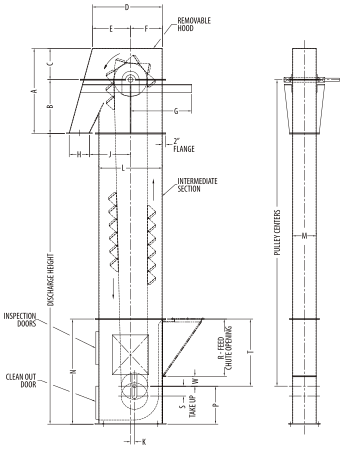
Capacities shown are preliminary and depend on material density, bucket fill, operating speed and feed conditions. Final dimensions and equipment selection must be confirmed for the specific application.
| Model number | Suffix | Bucket | Belt | Bucket Capacity | Elevator Capacity | Rate @ | Head Section | Pulley Offset | Casing | Boot Section | |||||||
|---|---|---|---|---|---|---|---|---|---|---|---|---|---|---|---|---|---|
| Size (x, y, z) | Width (in.) |
Gross Cu. Ft. |
Net Cu. Ft. |
CFH | 50 lbs./cu.ft. STPH |
100 lbs./cu.ft. STPH |
A | D | H | J | K | L | M | N | R | ||
| (inch) | |||||||||||||||||
| Single Row Elevators | |||||||||||||||||
| PR-BE-C-85 | * | 8 x 5 x 7 ¾ | 9 | 0.075 | 0.056 | 1,010 | 25.3 | 50.5 | 3′-9″ | 3′-9″ | 1′-0″ | 2′-1″ | 2″ | 3′-2 ½″ | 14.5 | 6′-6″ | 3′-3″ |
| PR-BE-C-1055 | * | 10 x 5 ½ x 8 ¾ | 11 | 0.114 | 0.086 | 1,370 | 34.3 | 68.5 | 4′-0 ½″ | 3′-9 ⅝″ | 1′-0″ | 2′-2″ | 2″ | 3′-3 ½″ | 16.5 | 6′-6″ | 3′-0 ½″ |
| PR-BE-C-126 | * | 12 x 6 x 11 ¾ | 13 | 0.165 | 0.124 | 1,490 | 37.3 | 74.5 | 4′-0″ | 3′-10 ¼″ | 1′-0″ | 2′-2″ | 2″ | 3′-4 ½″ | 17.5 | 6′-6″ | 3′-0″ |
| PR-BE-C-88 | * | 8 x 8 x 11 ¾ | 9 | 0.195 | 0.146 | 1,760 | 44.0 | 88.0 | 4′-0″ | 3′-10 ¼″ | 1′-0″ | 2′-2″ | 2″ | 3′-4 ½″ | 18.5 | 8′-0″ | 3′-0″ |
| PR-BE-C-116 | * | 11 x 6 x 8 ¾ | 12 | 0.150 | 0.113 | 1,800 | 45.0 | 90.0 | 5′-5″ | 4′-9″ | 1′-3″ | 2′-10″ | 3″ | 4′-0 ½″ | 14.5 | 8′-0″ | 3′-9″ |
| PR-BE-C-126 | * | 12 x 6 x 8 ¾ | 13 | 0.165 | 0.124 | 1,980 | 49.5 | 99.0 | 5′-5″ | 4′-9″ | 1′-3″ | 2′-10″ | 3″ | 4′-0 ½″ | 16.5 | 8′-0″ | 3′-9″ |
| PR-BE-C-127 | * | 12 x 7 x 11 ¾ | 13 | 0.225 | 0.169 | 2,030 | 50.8 | 101.5 | 4′-10″ | 4′-0 ¾″ | 1′-0″ | 2′-5″ | 3″ | 3′-8 ½″ | 18.5 | 8′-0″ | 3′-11″ |
| PR-BE-C-108 | * | 10 x 8 x 11 ¾ | 11 | 0.246 | 0.185 | 2,210 | 55.3 | 110.5 | 5′-6″ | 4′-7 ¾″ | 1′-3″ | 2′-10″ | 3″ | 3′-10 ½″ | 18.5 | 8′-0″ | 3′-10″ |
| PR-BE-C-147 | * | 14 x 7 x 11 ¾ | 15 | 0.264 | 0.198 | 2,380 | 59.5 | 119.0 | 5′-5″ | 4′-9″ | 1′-3″ | 2′-10″ | 3″ | 4′-0 ½″ | 18.5 | 8′-0″ | 3′-9″ |
| PR-BE-C-128 | * | 12 x 8 x 11 ¾ | 13 | 0.296 | 0.222 | 2,660 | 66.5 | 133.0 | 5′-6″ | 4′-7 ¾″ | 1′-3″ | 2′-10″ | 3″ | 3′-10 ½″ | 20.5 | 8′-0″ | 3′-10″ |
| PR-BE-C-148 | * | 14 x 8 x 11 ¾ | 15 | 0.340 | 0.255 | 3,060 | 76.5 | 153.0 | 5′-5″ | 4′-9″ | 1′-3″ | 2′-10″ | 3″ | 4′-0 ½″ | 20.5 | 8′-0″ | 3′-9″ |
| PR-BE-C-168 | * | 16 x 8 x 11 ¾ | 18 | 0.396 | 0.297 | 3,560 | 89.0 | 178.0 | 5′-5″ | 4′-9″ | 1′-3″ | 2′-10″ | 3″ | 4′-0 ½″ | 22.5 | 8′-0″ | 3′-9″ |
| PR-BE-C-188 | * | 18 x 8 x 11 ¾ | 20 | 0.448 | 0.336 | 4,030 | 100.8 | 201.5 | 5′-5″ | 4′-9″ | 1′-3″ | 2′-10″ | 3″ | 4′-0 ½″ | 24.5 | 8′-0″ | 3′-9″ |
| PR-BE-C-208 | * | 20 x 8 x 11 ¾ | 22 | 0.500 | 0.375 | 4,500 | 112.5 | 225.0 | 5′-5″ | 5′-0″ | 1′-6″ | 2′-10″ | 3″ | 4′-0 ½″ | 26.5 | 8′-0″ | 3′-9″ |
| PR-BE-C-228 | * | 22 x 8 x 11 ¾ | 24 | 0.549 | 0.412 | 4,940 | 123.5 | 247.0 | 5′-5″ | 5′-0″ | 1′-6″ | 2′-10″ | 3″ | 4′-0 ½″ | 28.5 | 8′-0″ | 3′-9″ |
| PR-BE-C-248 | * | 24 x 8 x 11 ¾ | 26 | 0.600 | 0.450 | 5,400 | 135.0 | 270.0 | 5′-5″ | 5′-0″ | 1′-6″ | 2′-10″ | 3″ | 4′-0 ½″ | 30.5 | 8′-0″ | 3′-9″ |
| PR-BE-C-1612 | * | 16 x 12 x 17 ¾ | 18 | 0.900 | 0.675 | 5,400 | 135.0 | 270.0 | 6′-11″ | 5′-10 ½″ | 1′-9″ | 3′-4″ | 3″ | 5′-0 ½″ | 22.5 | 10′-0″ | 4′-3″ |
| PR-BE-C-2012 | * | 20 x 12 x 17 ¾ | 22 | 1.130 | 0.848 | 6,780 | 169.5 | 339.0 | 6′-11″ | 5′-10 ½″ | 1′-9″ | 3′-4″ | 3″ | 5′-0 ½″ | 26.5 | 10′-0″ | 4′-3″ |
| PR-BE-C-2412 | * | 24 x 12 x 17 ¾ | 26 | 1.360 | 1.020 | 8,160 | 204.0 | 408.0 | 6′-11″ | 5′-10 ½″ | 1′-9″ | 3′-4″ | 3″ | 5′-0 ½″ | 30.5 | 10′-0″ | 4′-3″ |
| PR-BE-C-3012 | * | 30 x 12 x 17 ¾ | 32 | 1.710 | 1.283 | 10,260 | 256.5 | 513.0 | 6′-11″ | 5′-10 ½″ | 1′-9″ | 3′-4″ | 3″ | 5′-0 ½″ | 36.5 | 10′-0″ | 4′-3″ |
| PR-BE-C-3612 | * | 36 x 12 x 17 ¾ | 38 | 2.050 | 1.538 | 12,300 | 307.5 | 615.0 | 6′-11″ | 5′-10 ½″ | 1′-9″ | 3′-4″ | 3″ | 5′-0 ½″ | 42.5 | 10′-0″ | 4′-3″ |
| PR-BE-C-4212 | * | 42 x 12 x 17 ¾ | 44 | 2.400 | 1.800 | 14,400 | 360.0 | 720.0 | 6′-11″ | 5′-10 ½″ | 1′-9″ | 3′-4″ | 3″ | 5′-0 ½″ | 48.5 | 10′-0″ | 4′-3″ |
| PR-BE-C-4812 | * | 48 x 12 x 17 ¾ | 50 | 2.740 | 2.055 | 16,440 | 411.0 | 822.0 | 6′-11″ | 5′-10 ½″ | 1′-9″ | 3′-4″ | 3″ | 5′-0 ½″ | 54.5 | 10′-0″ | 4′-3″ |
| PR-BE-C-4216 | * | 42 x 16 x 23 ¾ | 44 | 4.260 | 3.195 | 19,170 | 479.3 | 958.5 | 8′-3″ | 6′-5 ½″ | 2′-0″ | 3′-8″ | 3″ | 5′-8 ½″ | 48.5 | 10′-0″ | 4′-11″ |
| PR-BE-C-4816 | * | 48 x 16 x 23 ¾ | 50 | 4.880 | 3.660 | 21,960 | 549.0 | 1,098.0 | 8′-3″ | 6′-5 ½″ | 2′-0″ | 3′-8″ | 3″ | 5′-8 ½″ | 54.5 | 10′-0″ | 4′-11″ |
| Double Row Elevators | |||||||||||||||||
| PR-BE-DC-168 | * | (2) 16 x 8 x 11 ¾ | 34 | 0.396 | 0.246 | 5,890 | 147.3 | 294.5 | 5′-5″ | 4′-10″ | 1′-6″ | 2′-10″ | 3″ | 4′-2 ½″ | 38.5 | 8′-0″ | 3′-9″ |
| PR-BE-DC-208 | * | (2) 20 x 8 x 11 ¾ | 42 | 0.500 | 0.310 | 7,440 | 186.0 | 372.0 | 5′-5″ | 5′-1″ | 1′-6″ | 2′-10″ | 3″ | 4′-2 ½″ | 50.5 | 8′-0″ | 3′-9″ |
| PR-BE-DC-228 | * | (2) 22 x 8 x 11 ¾ | 46 | 0.549 | 0.340 | 8,170 | 204.3 | 408.5 | 5′-5″ | 5′-1″ | 1′-6″ | 2′-10″ | 3″ | 4′-2 ½″ | 54.5 | 8′-0″ | 3′-9″ |
| PR-BE-DC-1612 | * | (2) 16 x 12 x 17 ¾ | 34 | 0.900 | 0.558 | 8,930 | 223.3 | 446.5 | 6′-11″ | 5′-11 ½″ | 1′-9″ | 3′-4″ | 3″ | 5′-2 ½″ | 38.5 | 10′-0″ | 4′-3″ |
| PR-BE-DC-2012 | * | (2) 20 x 12 x 17 ¾ | 42 | 1.130 | 0.701 | 11,210 | 280.3 | 560.5 | 6′-11″ | 5′-11 ½″ | 1′-9″ | 3′-4″ | 3″ | 5′-2 ½″ | 46.5 | 10′-0″ | 4′-3″ |
| PR-BE-DC-2412 | * | (2) 24 x 12 x 17 ¾ | 50 | 1.360 | 0.843 | 13,490 | 337.3 | 674.5 | 6′-11″ | 5′-11 ½″ | 1′-9″ | 3′-4″ | 3″ | 5′-2 ½″ | 54.5 | 10′-0″ | 4′-3″ |
PR-BE- identifies a Ward bucket elevator product.
D identifies a double-row elevator. CD means centrifugal discharge; C means continuous discharge; M means mill; and SC means super capacity.
The product number then includes the model number, such as PR-BE-DC-208. Suffix B identifies belt construction and suffix C identifies chain construction.
Engineering notes: Belt speeds outside the range of 200 to 330 fpm are custom designs. For Mill and Super Capacity elevators, contact our engineering team for details.
Table dimensions are based on 6-inch boot take-up. For other take-up lengths, contact our engineering team. All tabular information is subject to change without notice. Actual dimensions will be supplied with your order.
Both centrifugal and continuous elevators can be built with a belt or chain conveying element.
Belt elevators are often selected for cleaner materials, higher operating speeds, quieter operation and lower rotating mass. Belt tension, temperature rating, material compatibility, tracking, bucket fasteners and splice design must be considered.
Chain elevators are commonly used for hot, abrasive, heavy or severe-duty applications. Chain pitch, attachments, sprockets, lubrication, alignment and wear allowance must be matched to the duty.
Final selection depends on material temperature, loading, speed, environment and maintenance requirements.
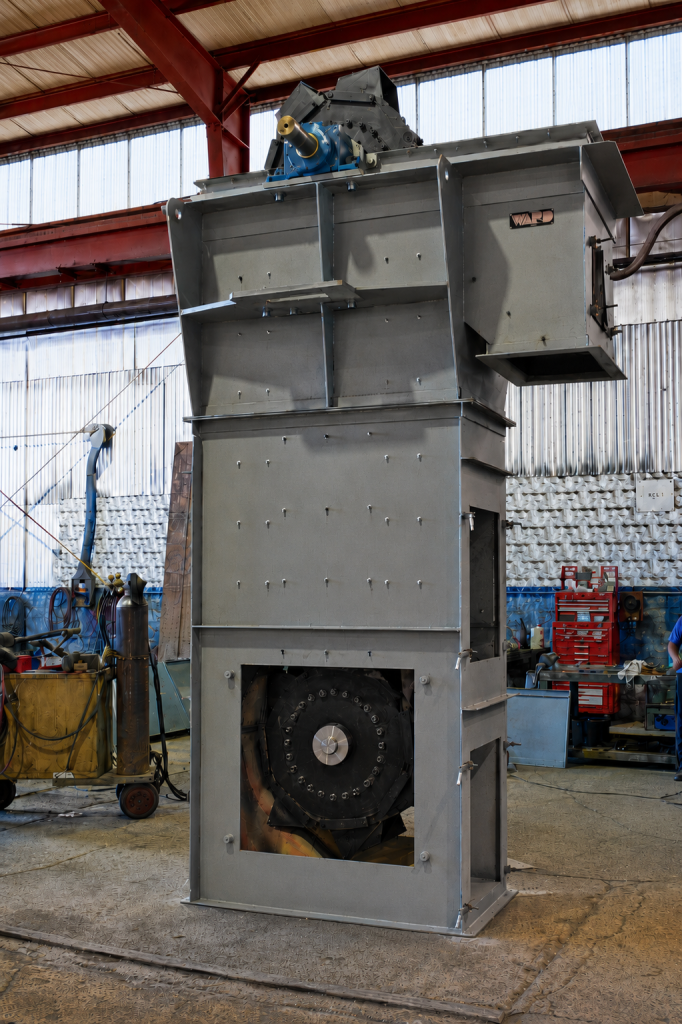
The following information should be reviewed before selecting or sizing an elevator:
Theoretical capacity is only one part of the selection process. Actual performance depends on bucket fill, feed consistency, elevator speed, material behaviour and discharge efficiency.
Bucket elevators may be based on standard models or engineered for the material, capacity, lift and plant arrangement.
| Material or Application | Typical Elevator Arrangement | Important Considerations |
|---|---|---|
| Dry, Free-Flowing Powders and Granules | Centrifugal belt or chain | Commonly suited to materials with small to moderate lump sizes and predictable discharge characteristics. |
| Grain, Seeds and Beans | Centrifugal belt | Often used for higher-capacity handling. Dust control, product damage and combustible-dust hazards must be considered. |
| Fragile or Degradation-Sensitive Materials | Continuous belt or chain | Lower-speed, controlled discharge can reduce impact and product breakage. |
| Abrasive Sand, Minerals and Aggregates | Continuous chain or heavy-duty centrifugal chain | Wear-resistant buckets, liners, sprockets, chains and accessible cleanout areas may be required. |
| Cement, Clinker, Lime and Gypsum | Heavy-duty centrifugal or continuous chain | Abrasion, dust, material temperature, buildup and casing wear must be considered. |
| Foundry Sand, Coke and Slag | Heavy-duty chain or mill-duty elevator | Severe abrasion, elevated temperature, impact loading and maintenance access are important. |
| Large Lumps or Heavy Material | Continuous or super-capacity chain | Larger buckets, controlled feeding, heavy-duty chain and lower operating speed may be required. |
| Wet, Sticky or Packing Materials | Application-specific centrifugal or continuous design | Bucket profile, direct feeding, coatings, cleanout access and buildup prevention are critical. |
| Hot Materials | Chain elevator with temperature-rated components | Buckets, chain, shafts, bearings, seals and casing materials must suit the operating temperature. |
| Salt, Fertilizer and Corrosive Chemicals | Belt or chain with corrosion-resistant construction | Stainless steel, protective coatings, sealed casing and compatible bucket materials may be required. |
| Light, Fluffy or Aerated Materials | Application-specific belt or chain elevator | Controlled feeding, air venting, bucket fill and dust containment require special attention. |
| High-Capacity or High-Lift Severe Duty | Super-capacity continuous chain | Double-strand chain, large continuous buckets, heavy shafts and robust take-up systems may be appropriate. |
This table is a preliminary guide only. Final elevator selection depends on the material’s bulk density, maximum lump size, flowability, abrasiveness, temperature, moisture, degradation characteristics, required capacity and vertical lift.
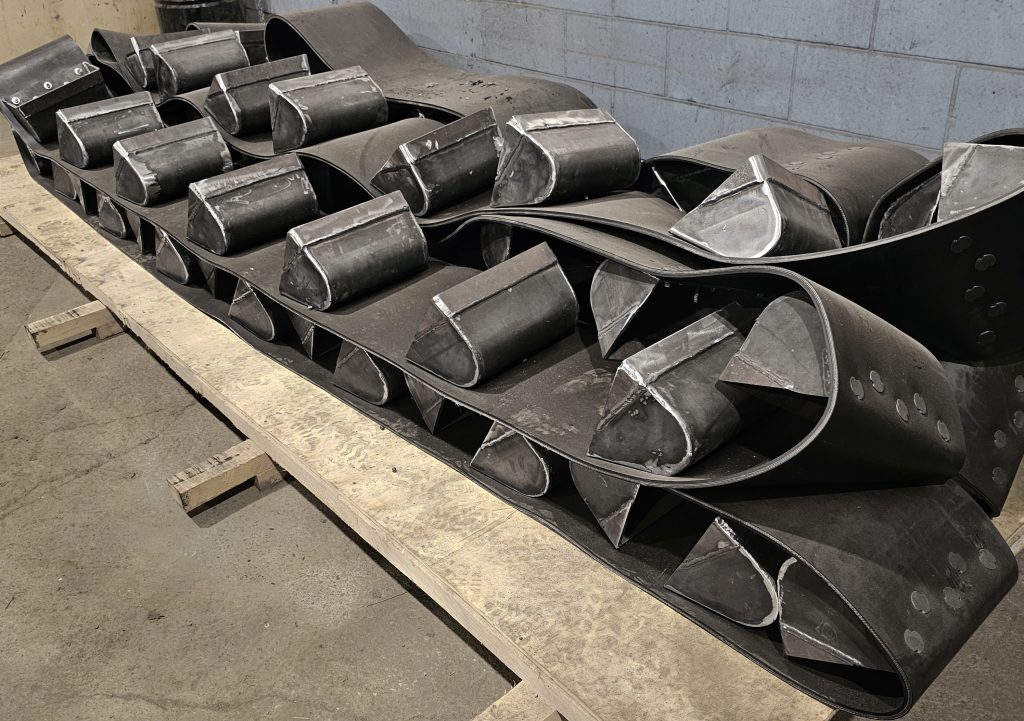
Ward can assist with maintenance requirements, replacement components and repairs for existing bucket elevators. Support may include buckets, belts, chains, sprockets, pulleys, shafts, bearings, take-ups, drives, casing repairs, wear liners and inlet or discharge modifications.
Routine inspection should include belt tracking and tension, chain wear, bucket condition, fasteners, pulley or sprocket wear, bearings, take-up travel, shaft alignment, casing leakage, material buildup and drive condition.
Replacement parts can often be identified from an original model number, drawing, equipment nameplate, sample component, photographs or field measurements.
Useful information includes bucket length, projection and depth; material and thickness; hole spacing and bolt diameter; belt width or chain attachment; bucket spacing; handled material; operating temperature; and elevator speed.
Capacity is based on working bucket volume, bucket spacing, number of rows and operating speed. Bulk density converts the volumetric rate into a mass flow rate. Actual capacity must account for bucket fill, feed consistency and discharge efficiency.
In many cases, yes. The most useful information is the existing bucket dimensions, hole pattern, belt width or chain attachment, bucket spacing, handled material and photographs. Original model numbers or drawings are particularly helpful.
Provide the material, capacity, bulk density, maximum lump size, temperature, vertical lift, feed arrangement, discharge elevation and operating conditions.
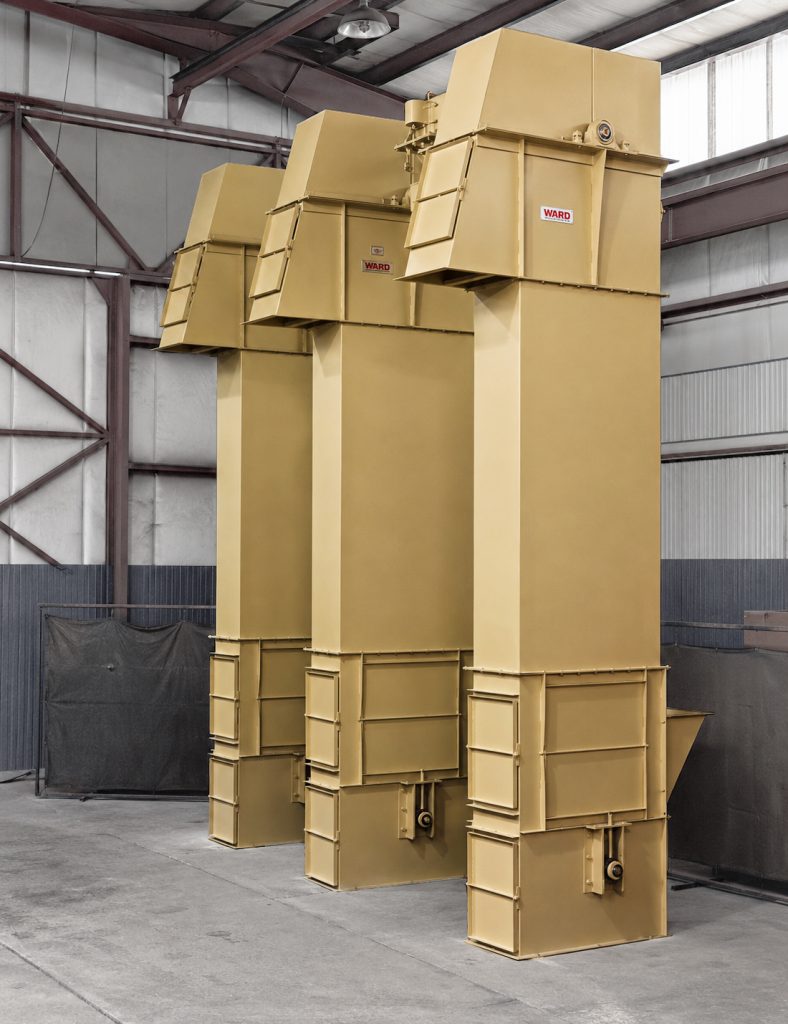
Ward can assist with new bucket elevators, application-specific designs, replacement components and evaluations of existing equipment.
For a new elevator, provide the material, required capacity, bulk density, lump size, temperature, vertical lift and operating conditions.
For replacement buckets or components, provide the equipment model, photographs and available field dimensions.
Contact Ward Industrial Equipment to discuss your bucket elevator application.